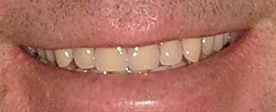
My smile looks terrible, so I don't smile any more. I can't afford the dentistry. What can I do?
How many times do I get asked this question! Usually it is from a new patient who I have never seen before and they have come in to see what we can do about their smile.
So many people assume that it is just to expensive so they never come in and even ask the question. That is the worst situation because for many people the fix really isn't that bad or that expensive. You really need to ask the question so that you can get an answer.
Many people assume that things are terrible when the solutions are often small and simple.
There are of course cases that are more complicated and more expensive but let's go over some cases and see some solutions. Of course I can in no way cover all the possible scenarios but here are just a few easy ones.
"My teeth are yellow and they embarrass me". The solution is teeth whitening! From in office to buying whited strips at Walmart. Both work well and you can keep your cost low.
"Crooked teeth". I always wanted straight teeth but couldn't afford it. I refer to the orthodontist. The typical case is $6-7,000 dollars (CDN). The people I work with ask for a deposit then they put you on a payment plan for about 2 years so it works out to about $200 dollars a month after the deposit. Sometimes, if patients are hard up for the deposit then I will speak to the Orthodontist and sometimes I can get the deposit waved and get them more payments.
Now comes the tricky stuff where it is more difficult to give you an idea of cost without seeing the case.
Sometimes a patient needs all their teeth out and new dentures made. The cost of the extractions will depend on how many teeth are left and how difficult the extractions. Then the cost of new dentures. There are some extra costs, not really hidden as your dentist will discuss these with you before you start. No dentist likes to get into a situation of "I didn't know" or " you didn't tell me". These costs include things such as immediate denture cost (denture going in at time of extraction) and reline costs (to make the denture fit the gums after a few months). Also a possible remake of the denture if it still doesn't fit well because the gums need time to settle to their final shape after the extractions. If you can wait two to three months after the extraction to make the dentures you can save yourself a lot of these costs.
These are before and after dentures. Not bad!
Of course not everyone needs dentures. Some people just need to replace there existing fillings and make them look good.
Here we just cleaned the gums and so you can see the red line around the gums disappear and now look pink. We replaced the fillings in her four front teeth and just did a better job. The result was great. The cost including the cleaning was about $1200.
Of course I am cherry picking here. There are cases which are a lot more expensive but if you don't ask you won't know. Perhaps your solution is not as complicated as you thought it would be.
All the best
Dr. Ron Barzilay
www.rondentist.com
enjoying dentistry in Hamilton Ontario
If you have any questions, just send them as a comment to the blog and I will reply.
Showing posts with label Dental Cleaning. Show all posts
Wednesday, November 7, 2018
Sunday, September 18, 2016
Should I go to the Dentist if I am Pregnant and what can I have done?
Should I go to the dentist if I am pregnant and what can I have done?
This question comes up often. Unfortunately it mostly comes up when the pregnant patient is in pain.
In this situation the answer is quite simple, of course you can go to the dentist. There is no question here. If you broke your arm while pregnant would you not go to the hospital? Of course you would and you know that they would take the xrays needed and give you medication as required.
If you had a tooth ache, we would take xrays as required and do treatment as required. We would also give you any medication required. Having said this, a shield always covers the fetal area when giving you x-rays (dental xrays are minimal amounts to begin with). Also most professionals will do their best to give medications which have the least affect on the fetus.
If you are planning on getting pregnant, it is a good idea to have your teeth checked first and to make sure that you do not have dental problems that could lead to pain or infection during pregnancy. If you have fillings to do we generally try to do them in the second trimester. Small fillings can wait but anything that is quite large can become painful and infected if not treated early. If that happens then that can involve a lot more things for the unborn child than the filling would have.
Also we do recommend extra cleanings during pregnancy as the hormonal change in a women's body during pregnancy causes a more exagerated response of the gums to the bacteria in the mouth resulting in a greater amount of inflammation of the gums. This inflammation can manifest as swollen and bleeding gums which may be uncomfortable.
The short is you can and should go to your dentist during pregnancy and don't hesistate to ask your dentist regarding any concerns which you may have.
All the best
Dr. Ron Barzilay
Having fun in Hamilton Ontario.
www.rondentist.com
This question comes up often. Unfortunately it mostly comes up when the pregnant patient is in pain.
In this situation the answer is quite simple, of course you can go to the dentist. There is no question here. If you broke your arm while pregnant would you not go to the hospital? Of course you would and you know that they would take the xrays needed and give you medication as required.
If you had a tooth ache, we would take xrays as required and do treatment as required. We would also give you any medication required. Having said this, a shield always covers the fetal area when giving you x-rays (dental xrays are minimal amounts to begin with). Also most professionals will do their best to give medications which have the least affect on the fetus.
If you are planning on getting pregnant, it is a good idea to have your teeth checked first and to make sure that you do not have dental problems that could lead to pain or infection during pregnancy. If you have fillings to do we generally try to do them in the second trimester. Small fillings can wait but anything that is quite large can become painful and infected if not treated early. If that happens then that can involve a lot more things for the unborn child than the filling would have.
Also we do recommend extra cleanings during pregnancy as the hormonal change in a women's body during pregnancy causes a more exagerated response of the gums to the bacteria in the mouth resulting in a greater amount of inflammation of the gums. This inflammation can manifest as swollen and bleeding gums which may be uncomfortable.
The short is you can and should go to your dentist during pregnancy and don't hesistate to ask your dentist regarding any concerns which you may have.
All the best
Dr. Ron Barzilay
Having fun in Hamilton Ontario.
www.rondentist.com
Wednesday, January 9, 2013
It's ok to pull that tooth Doc, I already stopped my Blood thinners!
Doc, it is OK to pull that tooth, I have already stopped my blood thinners!
WELL WHO ASKED YOU TO STOP YOUR BLOOD THINNERS?
Alot of patients coming into the office, are on blood thinners and have a lot of questions. Some patients come into the office and are on blood thinners and already have the answers.
Most people who are taking blood thinners are taking them to prevent blood clots in their blood vessels that could end up moving and blocking major vessels or structures. The ensuing loss of oxygen to the blocked structures could have major consequences for the patient, including death.
This is a concern in dentistry since almost every procedure we do may cause bleeding. From fillings, to cleanings, to extractions, to periodontal surgery, to root canals and so on. In dealing with the thousands of patients that we have here in our office we must always be careful with those patients who have bleeding tendencies.
Bleeding tendencies can be subidivided into those patients who have natural bleeding disorders and those patients whose bleeding is caused by medication that they are taking to "thin" the blood. In this blog I am talking about those patients taking blood thinners as those are the majority we see.
Many patients are taking Warfarin type medications and many are taking Aspirin. Those patients taking Warfarin medications can have a largely increased clotting time. Those patients on Warfarin have a test done called INR (international normalized ratio). This INR is a target goal for coagulation depending on the underlying condition so that a patients' dosage is adjusted to the target goal. In most situations a dentist can still work without having the patient stop his medication. This will depend on the patient specific factors such as the INR, patients overall health, expected bleeding and the length of the procedure.
Many patients are on low dose Aspirin. This usually does not represent a problem and most dental procedures can go ahead without any change.
Patients on Heparin are usually in a hospital setting so that is really not an issue but today there is is LMWHs (low molecular weight heparin) which allows the use of Heparin type medication outside the hospital setting and this may require stopping a patients medication.
After all this, the question really is what should you the patient be doing? The answer is very simple. Speak to your dentist, he will have the answers and if he doesn't he will be in touch with your physicians to dicuss the proper treatment for your specific situation. In most cases you will not have to ask your dentist as your dentist will be discussing it with you. In consultation with your physician he will tell you wether you need to stop medication or continue. Most important never do anything on your own. Stopping your medication even for a short time on your own may have a very negative affect. No matter what you read on the internet or heard on Oprah. Speak to your dentist, because every situation is different and there are no cookie cutter solutions.
All the best
Dr. Ron Barzilay
enjoying dentistry in Hamilton, Ontario Canada
www.rondentist.com
WELL WHO ASKED YOU TO STOP YOUR BLOOD THINNERS?
Alot of patients coming into the office, are on blood thinners and have a lot of questions. Some patients come into the office and are on blood thinners and already have the answers.
Most people who are taking blood thinners are taking them to prevent blood clots in their blood vessels that could end up moving and blocking major vessels or structures. The ensuing loss of oxygen to the blocked structures could have major consequences for the patient, including death.
This is a concern in dentistry since almost every procedure we do may cause bleeding. From fillings, to cleanings, to extractions, to periodontal surgery, to root canals and so on. In dealing with the thousands of patients that we have here in our office we must always be careful with those patients who have bleeding tendencies.
Bleeding tendencies can be subidivided into those patients who have natural bleeding disorders and those patients whose bleeding is caused by medication that they are taking to "thin" the blood. In this blog I am talking about those patients taking blood thinners as those are the majority we see.
Many patients are taking Warfarin type medications and many are taking Aspirin. Those patients taking Warfarin medications can have a largely increased clotting time. Those patients on Warfarin have a test done called INR (international normalized ratio). This INR is a target goal for coagulation depending on the underlying condition so that a patients' dosage is adjusted to the target goal. In most situations a dentist can still work without having the patient stop his medication. This will depend on the patient specific factors such as the INR, patients overall health, expected bleeding and the length of the procedure.
Many patients are on low dose Aspirin. This usually does not represent a problem and most dental procedures can go ahead without any change.
Patients on Heparin are usually in a hospital setting so that is really not an issue but today there is is LMWHs (low molecular weight heparin) which allows the use of Heparin type medication outside the hospital setting and this may require stopping a patients medication.
After all this, the question really is what should you the patient be doing? The answer is very simple. Speak to your dentist, he will have the answers and if he doesn't he will be in touch with your physicians to dicuss the proper treatment for your specific situation. In most cases you will not have to ask your dentist as your dentist will be discussing it with you. In consultation with your physician he will tell you wether you need to stop medication or continue. Most important never do anything on your own. Stopping your medication even for a short time on your own may have a very negative affect. No matter what you read on the internet or heard on Oprah. Speak to your dentist, because every situation is different and there are no cookie cutter solutions.
All the best
Dr. Ron Barzilay
enjoying dentistry in Hamilton, Ontario Canada
www.rondentist.com
Subscribe to:
Posts (Atom)